The Executive Breakdown: When Leadership Capacity Meets Sustained Pressure
High-stakes leadership is often discussed in terms of strategy, decision-making and execution. Yet the capacity to sustain those demands is also shaped by the internal conditions from which a leader is operating.
Under prolonged pressure, leaders may experience changes in attention, emotional regulation, decision-making, communication and behavioural flexibility. These changes can appear externally as performance or organisational problems while reflecting a deeper challenge within the leadership system.
The question is therefore not only what a leader is doing, but also from what internal condition that leadership is being expressed.
This case study explores one such situation: a high-performing founder operating under sustained operational pressure whose ability to maintain vocal presence and hold difficult conversations became increasingly compromised.
Case Context: When Pressure Enters the Leadership System
The client was a high-performing founder navigating significant operational demands and repeated high-stakes interactions.
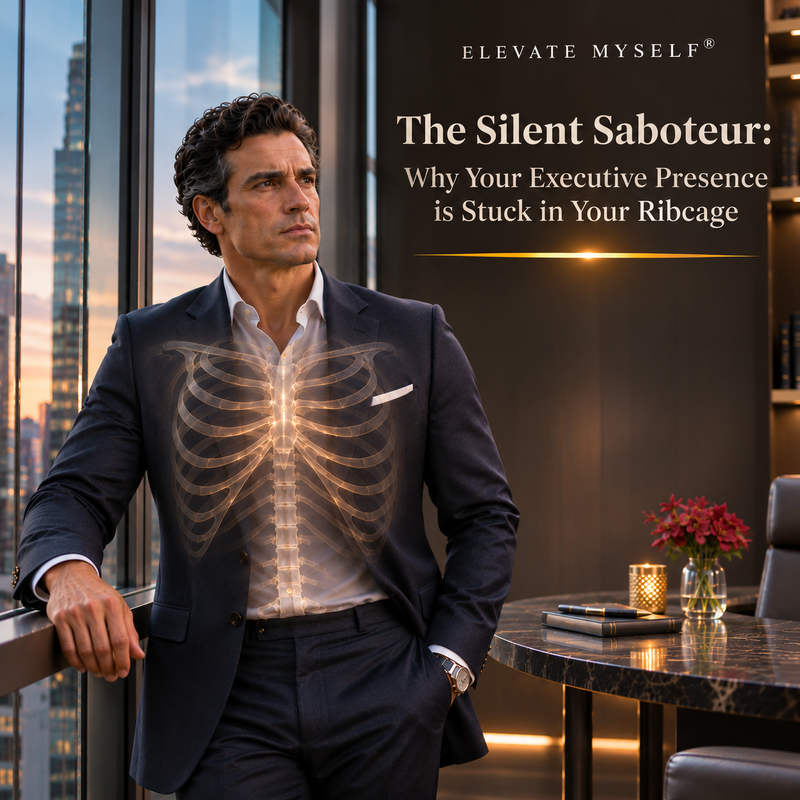
Under acute pressure, the client experienced a recurring pattern of physiological activation and behavioural response. In difficult confrontations, vocal expression could become restricted, making it difficult to hold a position with the clarity and authority the situation required.
The response was not limited to the moment itself. The client described a cycle in which pressure could lead to inhibition and premature accommodation, followed by accumulated frustration, eventual reactive expression and, subsequently, exhaustion and regret.
From the outside, this could easily be interpreted as a communication, confidence or behavioural issue. The deeper inquiry was whether the behaviour was also connected to the internal conditions from which the leader was attempting to operate.
Observing the Physiological Response
As part of the developmental inquiry, we used a vocal-resonance exercise to observe what occurred in the client's system when initiating sustained vocal expression.
The exercise revealed a pronounced increase in physiological arousal accompanied by muscular contraction and difficulty sustaining relaxed vocal expression.
The pattern was explored as a sequence:
STRATEGIC DEMAND / INITIATION ↓ INCREASED PHYSIOLOGICAL AROUSAL ↓ INCREASED VISCERAL AND RESPIRATORY TENSION ↓ RESTRICTION OF VOCAL EXPRESSION
The purpose of the exercise was not to establish a clinical diagnosis, but to make an otherwise difficult-to-observe pattern more visible to the leader. What mattered developmentally was the relationship between internal sensation, interpretation, behaviour and leadership context.
The Developmental Intervention
Activating the ELEVATE MYSELF® R.E.G.U.L.A.T.E. Framework™ AxisThe R.E.G.U.L.A.T.E. Framework™ was applied as a developmental architecture for examining the relationship between physiological state, internal patterns, behaviour and leadership demands.
Rather than treating the observed response as an isolated performance problem, the work explored the deeper patterns through which the leader experienced pressure, visibility, confrontation and responsibility. The process was intentionally developmental rather than presented as a clinical protocol.
Schema Extraction & Somatic Witnessing
The engagement began by mapping the client's internal schema — identifying recurring beliefs, interpretations and response patterns associated with high-stakes leadership situations.
Through somatic witnessing, the client was guided to observe physiological sensations with greater awareness rather than immediately identifying with or reacting to them. This created a greater distinction between what the body was experiencing, what the mind was interpreting and how the leader was choosing to respond.
The objective was not to eliminate physiological activation, but to increase the leader's capacity to recognise and work with it.
Relational Pattern Restructuring
The next stage examined how internal patterns were expressed within relationships and leadership situations.
The client explored the connection between perceived pressure, the impulse to accommodate, suppressed frustration and subsequent reactive behaviour. Through reflective inquiry and somatic awareness, the work focused on developing greater capacity to remain present while holding difficult conversations, boundaries and competing demands. The emerging shift was from automatic reaction toward greater awareness and choice.
From Individual Regulation to Leadership Capability
The significance of this case extends beyond the individual leader. Leadership behaviour does not occur in isolation. The internal conditions of senior leaders influence how they communicate, make decisions, respond to uncertainty and engage with others.
At executive-team level, repeated individual patterns can become relational dynamics. Over time, relational dynamics can influence culture, decision quality, execution and institutional capability. This is why ELEVATE MYSELF® approaches leadership development as a connected system rather than as an isolated intervention in individual behaviour.
Individual → Executive Team → Institution
The development of the person can therefore become part of the development of the system. This relationship between the human condition of leadership and the institutions that leadership creates is explored further in When Leadership Loses Its Humanity, which examines the broader consequences of leadership becoming increasingly separated from human responsibility, awareness and institutional stewardship.
Read the related essay: When Leadership Loses Its Humanity
The Leadership Implication
Sustainable leadership is not only a question of strategic intelligence or professional capability. It also requires sufficient internal capacity to remain present, discerning and responsive when circumstances become demanding. The deeper question is therefore from what internal condition is the leader operating?
Understanding that relationship can create a more complete approach to leadership development; one that connects the human system, leadership behaviour and institutional performance.
The work of the R.E.G.U.L.A.T.E. Framework™ is situated within this broader inquiry: how can leaders develop greater capacity to remain conscious, regulated and effective as the demands placed upon them increase?
ELEVATE MYSELF® Elite Alignment is a private advisory for global leaders, institutional architects and legacy builders seeking greater coherence between leadership, purpose and the institutions they shape.
Engagement is selective and begins with an Elevation Brief to understand the leader, the context and the developmental opportunity.
Request an Elevation Brief